Welcome To Hebei Xiongan Hengyun Technology Co., Ltd.
 Esperanto
 Shqiptare
 Euskara
 Zulu
 Latinus
 Cymraeg
 தமிழ்
 Slovak
 Slovak
 Afrikaans



Cost-Effective Chopped Strand Mat for Construction and Chemical Tank Manufacturing
2025-05-19
Cost-Effective Chopped Strand Mat for Construction and Chemical Tank Manufacturing
I. Overview
Fiberglass Chopped Strand Mat (CSM) is a non-woven reinforcing material made of short-cut glass fibres that are uniformly distributed without orientation and bonded by a binder. It is widely used in the manufacture of composite materials, such as glass reinforced plastic (FRP) products, automotive parts, ships, wind turbine blades and other fields. It has become one of the most commonly used reinforcing materials in the composites industry due to its low cost, easy moulding and balanced mechanical properties.
II. Main Composition and Structure
Fiberglass Chopped Strand Mat is mainly composed of two parts:
1. Glass fibre: Usually alkali-resistant glass fibre (E-glass) is used, which has the characteristics of high strength, corrosion resistance and electrical insulation. In special environments, alkali-resistant glass fibres (C-glass) or high-strength glass fibres (AR-glass) can also be used.
2. Binders: used to fix the fibres, usually divided into two categories:
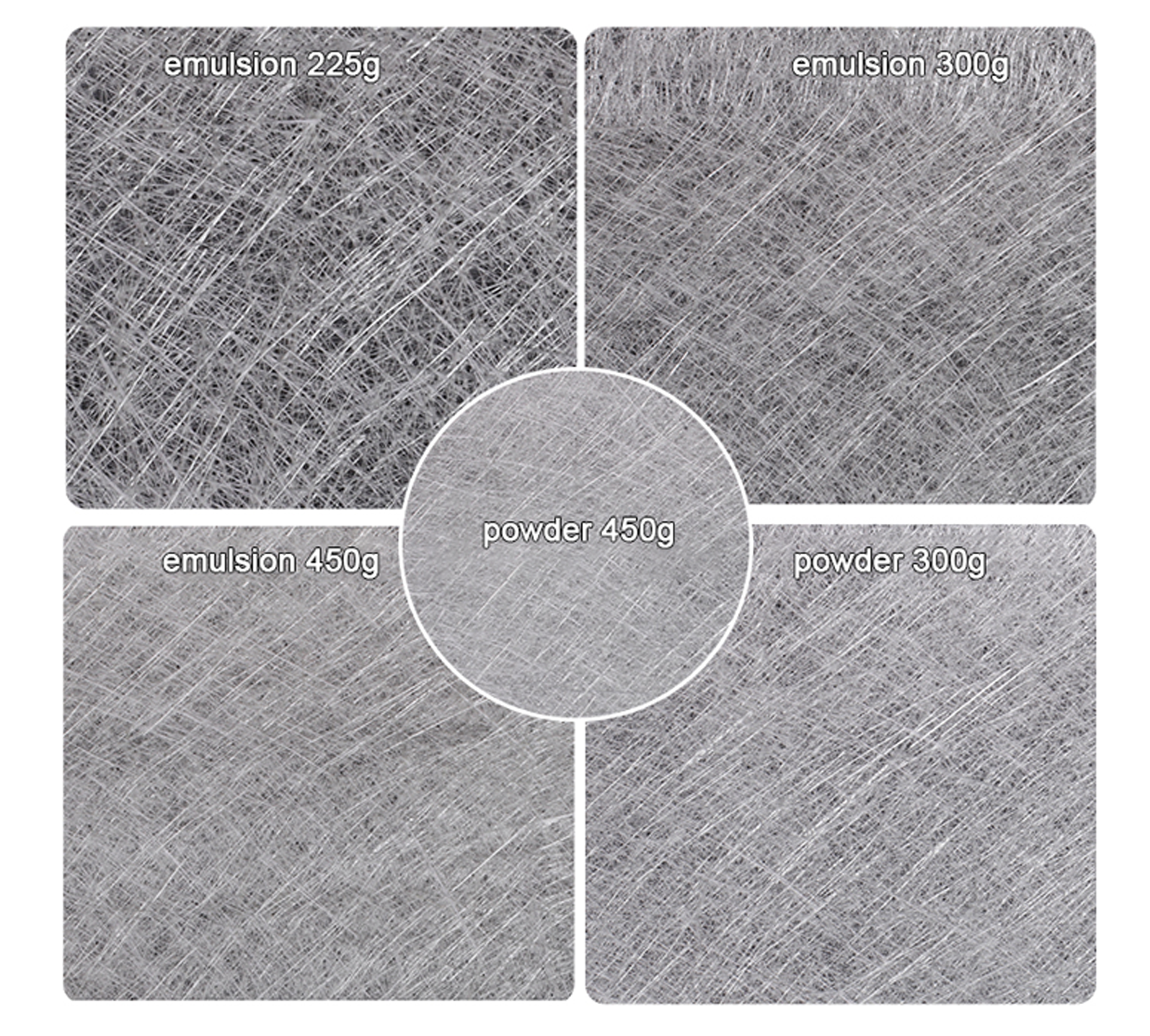
3. powder binders (e.g. polyester resin powder): melting at high temperatures, suitable for moulding processes.
4. emulsion binders (e.g. PVAc emulsion): can be dissolved at room temperature and are suitable for hand or spray moulding.
Short-cut fibres, usually 25-50mm in length, are evenly spread by airflow or wet process, then dried and cured to form a stable web structure.
III. Production Process
The manufacturing process of glass fibre short-cut mat mainly includes the following steps:
1. Preparation of raw glass fibre: The molten glass is drawn into continuous fibre with a diameter of 5-20μm.
2. Short-cutting: cut the continuous fibre into 25-50mm short fibres.
3. Felting: Uniform dispersion of fibres on a conveyor belt by airflow or wet process.
4. Binder application: Spraying of powder or emulsion binders to ensure bonding between the fibres.
5. Drying and curing: heating in an oven (100-200°C) to cure the binder and form a stable felt.
6. Rolling and packaging: cut into different widths (1-2m) and lengths (50-100m/roll) as required.
IV. Main Properties
Glass fibre chopped mat has the following outstanding properties:
1. Isotropic: random distribution of fibres makes the strength of the material uniform in all directions, which is suitable for products with complex shapes.
2. High resin infiltration: the loose structure of the fibres facilitates resin infiltration, reduces air bubbles and improves the quality of composite materials.
3. Light weight and high strength: low density (1.6-2.0g/cm³), but the strength is close to that of steel, suitable for lightweight design.
4. Corrosion resistance: resistant to acid, alkali, salt spray and organic solvents, suitable for chemical and marine environments.
5. Electrical insulation: non-conductive, can be used for electrical equipment insulation materials.
6. easy processing: can be cut, moulded, hand-paste forming, to adapt to a variety of process needs.
V. Fields of Application
Glass fibre chopped mats are widely used in the following industries:
1. Transport
Automobile: lightweight parts such as bumpers, body panels and chassis guards.
Ship: hull, deck, bulkhead and other FRP structures.
2. Construction and building materials
Waterproofing membrane, anti-corrosion roofing, wall reinforcement materials.
Cooling towers, ventilation pipes, septic tanks and other anti-corrosion structures.
3. Energy and Environmental Protection
Wind power blades, solar panels support.
Chemical storage tanks, flue gas desulphurisation equipment lining.
4. Electrical and electronic
Circuit substrate, insulation board, transformer isolation layer.
5. Other industrial fields
Sports equipment (such as surfboards, skis).
Military industry, aerospace (part of the non-bearing structural components).
VI. Conclusion
Fiberglass Chopped Strand Mat occupy an important position in the composites sector due to their excellent cost performance, ease of use and wide applicability. With the growing demand for environmental protection and high performance, it will move in a greener and smarter direction in the future, and continue to provide key material support for industries such as automotive, wind power and construction.
High resin compatibility,Marine composite materials,High tensile strength CSM,CSM glass fiber reinforcement
Related news



We produce building materials with glass fiber as the main product.Production headquarters is located in Xiongan New District.


Contact
Room 209, Building S6, 001 Baojing Road North, xiongxian, Baoding, Hebei

Learn more